4 Hidden Properties of Viton FKM Rubber Sheet | HyperSheet®
355 Views |

4 Hidden Properties of Viton (FKM) Rubber Sheets Most People Don't Know
It's About More Than Just Chemical, Oil, and Heat Resistance
When people talk about Viton rubber sheets or FKM sheets, most immediately think of three main properties: chemical resistance, oil resistance, and high heat resistance.
But in real world sealing applications, gaskets rarely fail simply because the rubber swells or cracks. More often, the real problem starts with something invisible the rubber failing to spring back fully after compression, gas slowly permeating through the material, or volatile compounds contaminating sensitive components nearby. And in applications with fuel or fire risk, how a seal behaves when exposed to flame matters just as much.
The true value of a Viton rubber sheet isn't just about being "resistant." It's about the material's ability to maintain its shape, flexibility, and sealing performance consistently over time even under repeated exposure to heat, chemicals, and other demanding conditions.
This article walks through 4 lesser known properties of FKM sheets that directly affect gasket lifespan and can significantly reduce costly machine downtime.
1. Low Compression Set — Recovers Well, Doesn't Deform Permanently
Compression Set measures how much a rubber material permanently deforms after being compressed for an extended period. The higher this value, the less the rubber springs back once pressure is released leaving it flattened, almost like it never had its original shape.
The tricky part: a gasket with a high compression set can still look perfectly intact no cracks, no visible damage while the sealing force between it and the flange surface quietly drops. Common warning signs on the shop floor include:
Oil or chemical seepage appearing after equipment runs hot
Having to re-torque flange bolts over and over again
Leaks starting to appear after repeated hot cold cycles
A gasket that looks fine but no longer seals properly, requiring replacement before the scheduled maintenance cycle
FKM rubber sheets are well known for their resistance to compression set and good resistance to media permeation but real world performance still depends on the specific compound formulation, hardness, operating temperature, exposure time, and compression rate of each application.
A common misunderstanding: a low compression set does NOT mean the rubber is soft or easy to compress. Softness is measured by hardness (Shore A) a completely different property. Two sheets with identical hardness can perform very differently in long term sealing. For pumps, valves, or piping systems that cycle through temperature swings, compression set can matter just as much as or more than the maximum temperature rating alone.
2. Good Flame Resistance — Buys Critical Time for Automatic Shutoff Systems
Another often-overlooked property, but a critical one for applications with fire risk, is FKM's ability to resist and slow down flame propagation.
FKM's molecular structure contains a significantly higher fluorine content than typical synthetic rubbers. As a result, FKM tends to be difficult to ignite, and once the flame source is removed, it typically self extinguishes unlike some rubber types that continue burning even after the flame is gone.
In a real fire scenario, before flames fully spread, ambient temperature often spikes rapidly. A heat resistant material like FKM holds its sealing force longer during this critical window potentially buying just enough time for an automatic fuel shutoff system to activate before damage escalates further.
This property is especially valuable in applications such as:
Oil and gas piping systems with fuel exposure risk
Drilling platforms and petrochemical refineries
Engine rooms or enclosed spaces where evacuation is difficult
Systems with automatic fuel shutoff that need a seal to "buy time" until shutoff engages
Important caveat: "Fire resistant" does not mean "won't burn at all." Also, a full assembly passing a fire test standard does not automatically mean a standalone FKM sheet cut for your application meets the same standard test results depend on the entire system, not the seal material alone. If your project requires certification to a specific fire test standard, communicate that requirement upfront when requesting a quote.
3. Low Gas Permeation
Many assume that if a gasket is properly installed with no visible leak path, gas simply cannot escape. In reality, certain gases can slowly migrate through a rubber material's molecular structure even without any visible holes or cracks. This phenomenon is known as gas permeation.
FKM has low gas permeability, and selecting the right polymer and compound formulation can further fine tune resistance to acids, fuels, water, and steam based on the specific application. This makes it well suited for applications demanding high sealing integrity, such as:
Gas and fuel systems
Vacuum systems
Pressure test chambers
Pumps and valves requiring tight leak control
Systems where minimizing vapor loss is critical
Instrumentation sensitive to internal pressure
4. Excellent UV, Ozone, and Weathering Resistance
Rubber doesn't only degrade from chemicals and heat oxygen, ozone, sunlight, and general weathering can cause many rubber types to crack, harden, or lose flexibility over time.
FKM offers strong resistance to media exposure, ozone, and age related degradation, along with good stability in fuels, petroleum oils, and many types of grease. This makes it well suited for components used in environments such as:
Outdoor installed machinery and equipment
Seal points constantly exposed to open air
Systems near motors or electrical equipment with ozone exposure
Petrochemical and outdoor energy systems
Covers, diaphragms, and gaskets used outside buildings
This advantage may not be obvious on day one of installation but it becomes increasingly meaningful once the material has to withstand real environmental conditions over months or years.
So, Who Actually Needs Viton (FKM) Rubber Sheets?
These 4 properties become especially important if your application faces situations like:
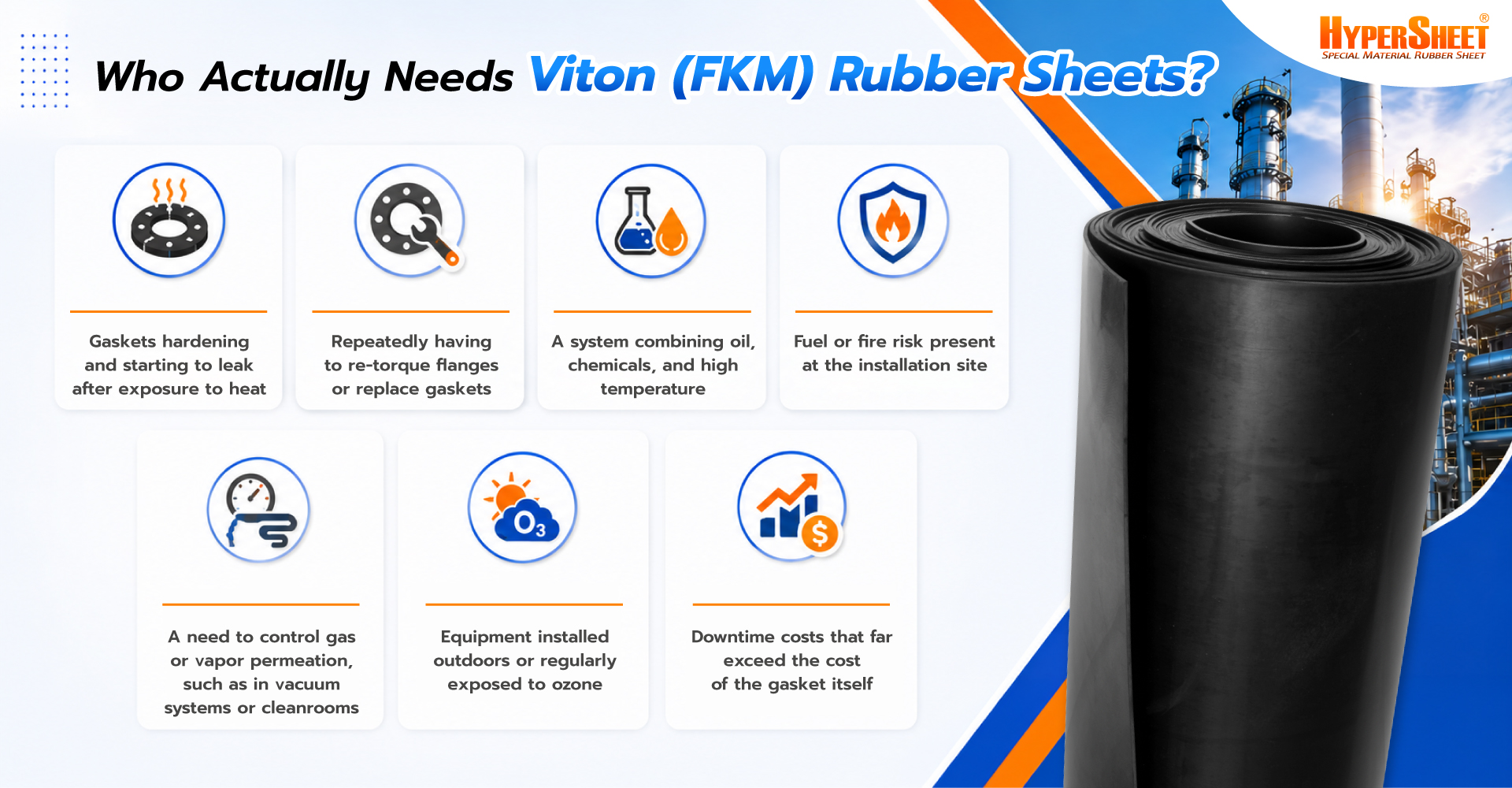
Gaskets hardening and starting to leak after exposure to heat
Repeatedly having to re-torque flanges or replace gaskets
A system combining oil, chemicals, and high temperature
Fuel or fire risk present at the installation site
A need to control gas or vapor permeation, such as in vacuum systems or cleanrooms
Equipment installed outdoors or regularly exposed to ozone
Downtime costs that far exceed the cost of the gasket itself
The real question isn't just "how many degrees can this rubber withstand?" It's whether, after real world use, the material still recovers its shape, maintains sealing force, and controls the specific risks your application demands.
Important Caveat: FKM Isn't a One-Size-Fits-All Material
Despite its many strengths, FKM isn't suited for every chemical or every condition. Standard grades may not perform well with certain polar solvents such as acetone, MEK, and ethyl acetate, as well as amines, strong bases, ammonia, glycol-based brake fluids, and superheated steam under certain conditions. Different compound formulations also vary in chemical resistance and low-temperature flexibility, so chemical compatibility should always be verified before selecting a material.
Choosing a rubber sheet based on the name "FKM" alone isn't enough. Before making a decision, it's worth confirming at least these 5 pieces of information:
| Information Needed | Details to Specify |
| 1. Chemical Type | The specific chemical(s) and concentration the seal will directly contact |
| 2. Temperature | Normal operating temperature and maximum temperature |
| 3. Pressure & Movement | Pressure level, and whether the seal point experiences movement |
| 4. Sheet Specifications | Hardness (Shore A), thickness, and required compression rate |
| 5. Special Requirements | e.g. Food Grade, Silicone Free, Low Outgassing, fire test standards, or industry-specific requirements |
HyperSheet® FKM Rubber Sheet: When Your Application Needs More Than Just "Heat Resistant"
For applications facing heat, oil, fuel, chemicals, or harsh environments all at once, HyperSheet® FKM rubber sheets are built to be cut into gaskets, seals, shims, and custom parts tailored to real application requirements.
The key isn't choosing the FKM grade with the highest specs on paper it's choosing the right compound, hardness, and thickness for the actual function the seal needs to perform.
Note: For applications requiring Food Grade, Silicone-Free, Low Outgassing, or specific fire test certification, please inform our Sales Engineer team when requesting a quote so we can verify the correct grade and supporting documentation for your needs.
Simply provide the following information to our Sales Engineer team:
Chemical type | Temperature | Pressure | Thickness | Size or gasket design
Our team can then help identify the right material for your application before you commit to purchase.
Talk to our Sales Engineer team and request a quote today
LINE: @ptirubber
Email: info@ptigroups.com
Tel: +66 2-257-7154 | +66 98-289-8676
HyperSheet® by Polytech Industry Company Limited


