Soundproof and Sound Absorbing Rubber Sheets Explained | HyperSheet® Noise Control
1834 Views |

What Are Soundproof Rubber Sheets and Sound-Absorbing Rubber Sheets?
A Practical Guide to Choosing Effective Noise Control Materials for Factories, Buildings, and Industrial Applications
Noise is one of the most underestimated hidden costs in many organizations—whether in industrial plants, office buildings, mechanical rooms, control rooms, or commercial spaces.
Loud noise, echo, and vibration are not just minor annoyances. They directly impact:
- Work efficiency and productivity
- Employee health and well-being
- Occupational health and safety compliance
- Brand image and organizational credibility
That’s why noise control materials are not “optional accessories.” They are an essential part of building and machine system design.
Two of the most commonly used solutions are soundproof rubber sheets and sound-absorbing rubber sheets. Although the names sound similar, their functions, working mechanisms, and results are clearly different. Choosing the wrong type may lead to poor noise reduction—and unnecessary repeat costs.
This article explains the fundamentals in a structured way: from basic sound behavior to key differences and how to use both together—so you can select the right solution from the start.
Understand Sound Basics Before Choosing Materials
Sound is vibration traveling through air. When a noise source—such as machinery, motors, or impact—occurs, sound can travel through:
- Air
- Walls
- Floors
- Building structures
In real applications, noise issues typically fall into two main categories:
- Sound transmission to other areas
For example, machine noise disturbing an adjacent office or nearby rooms. - Sound reflection within the same space
For example, a room with strong echo, unclear speech, and an uncomfortable working environment.
This is exactly where soundproof rubber sheets and sound-absorbing rubber sheets play very different roles.
What Is a Soundproof Rubber Sheet?
A soundproof rubber sheet is designed to reduce sound transmission and vibration transfer from one space to another.
Its primary goal is not to “absorb sound.”
It is to block sound from passing through.How Soundproof Rubber Sheets Work: Mass Law
How Soundproof Rubber Sheets Work : Mass Law

Soundproof rubber sheets operate based on Mass Law. In simple terms:
the greater the mass of a material, the harder it is for sound to pass through.
Therefore, soundproof rubber sheets are engineered to:
- Have high density
- Provide high mass per unit area
- Maintain suitable flexibility to help dampen vibration
When sound hits the sheet, sound energy is reduced, and vibration is less likely to transfer into surrounding structures.
NOTE: Create a new diagram with updated text for the Mass Law section.
What Types of Noise Do Soundproof Rubber Sheets Handle Well?
- Low-to-mid frequency noise
- Machinery noise
- Motor noise
- Structure-borne vibration noise
- Impact noise
Typical Applications
- Under machinery
- Lining mechanical room walls
- Floor and ceiling applications
- Separating factory areas from office zones
- Reducing noise leakage to surrounding areas
Quick summary:
Soundproof rubber sheet = reduces sound transmission
What Is a Sound-Absorbing Rubber Sheet?
A sound-absorbing rubber sheet is designed to absorb sound waves, reduce reflection, and minimize echo inside a space.
Its main purpose is not to prevent sound from leaving the room.
It is to improve acoustic comfort and sound quality within the room.
How Sound-Absorbing Rubber Sheets Work
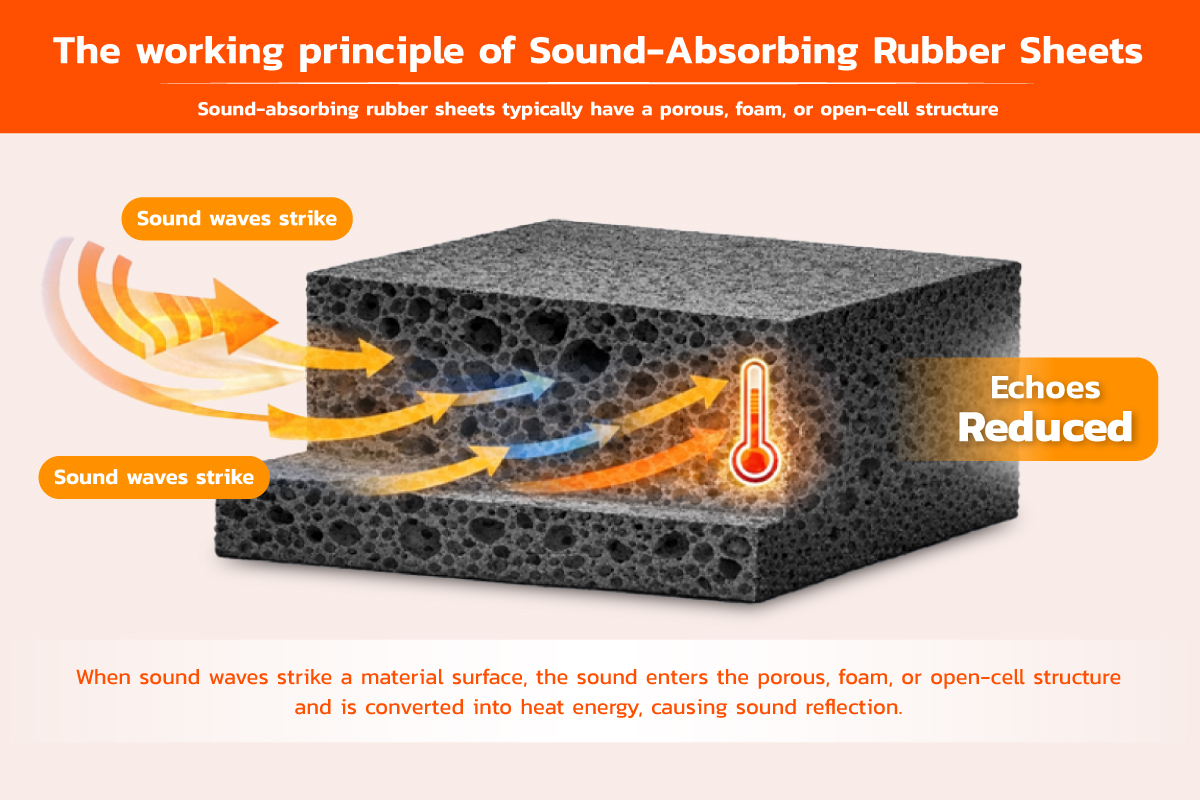
Sound-absorbing rubber sheets typically use structures such as:
- Porous surfaces
- Foam structures
- Open-cell structures
When sound waves hit the material, the sound enters the internal structure and is converted into heat energy, which reduces reflection and echo.
NOTE: Create a new diagram using HyperSheet sound-absorbing rubber visuals.
- Speech noise
- Reflected sound
- Echo / reverberation
- Mid-to-high frequency noise
Typical Applications
- Meeting rooms
- Control rooms
- Testing rooms
- Spaces requiring quieter, more comfortable acoustics
Quick summary:
Sound-absorbing rubber sheet = reduces sound reflection inside a space
Soundproof vs Sound Absorbing: Key Differences
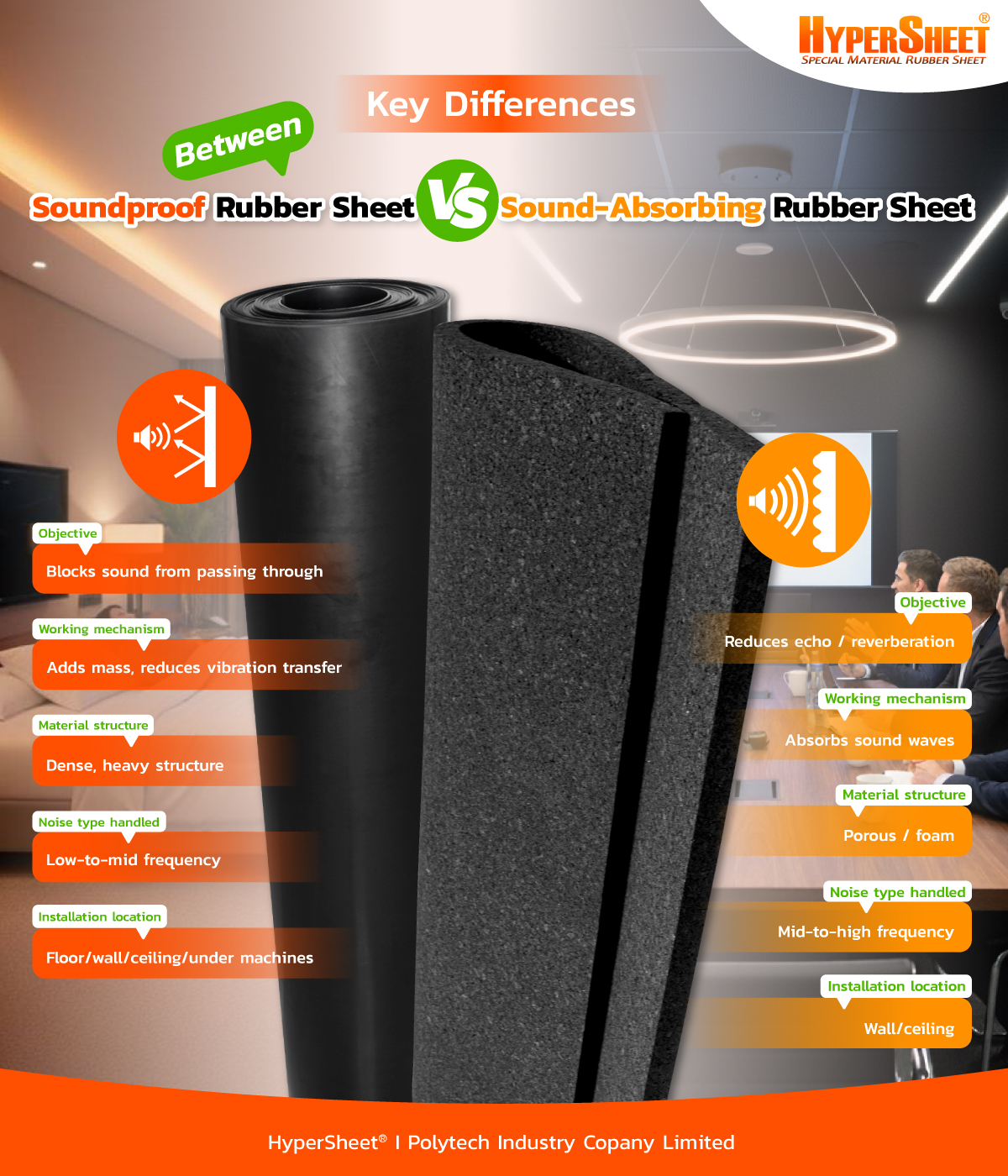
| Soundproof Rubber Sheet | Comparison Topic | Sound-Absorbing Rubber Sheet |
| Blocks sound from passing through | Objective | Reduces echo / reverberation |
| Adds mass, reduces vibration transfer | Working mechanism | Absorbs sound waves |
| Dense, heavy structure | Material structure | Porous / foam |
| Low-to-mid frequency | Noise type handled | Mid-to-high frequency |
| Floor / wall / ceiling / under machines | Installation location | Wall / ceiling |
Why Many Projects “Never Fully Solve” Noise Problems
Common causes include:
- Using general rubber sheets instead of true soundproof sheets
- Using sound-absorbing sheets when transmission blocking is needed
- Choosing by price rather than noise type
- Using only one material type for the entire system
Typical outcomes:
- Sound still leaks through
- Sound doesn’t leak, but the room feels acoustically uncomfortable
- Internal echo improves, but surrounding areas are still disturbed
- Rework is required—leading to unnecessary budget increases
What Works Best: Use Both as a “System”
Effective noise control often requires managing both issues together:
- Soundproof rubber sheet - controls sound transmission and vibration transfer
- Sound-absorbing rubber sheet - improves acoustic comfort by reducing reflection inside the space
When used together, you can achieve:
- A real reduction in overall noise level
- Clearly reduced echo and reverberation
- Better working conditions
- Lower risk of complaints and health-related impacts
HyperSheet® — Noise Control Rubber Sheets for Industrial Applications
HyperSheet® is developed specifically for factories, buildings, and commercial projects.
It is not designed for “minor improvement.” It focuses on practical, long-term performance.
Key Benefits of HyperSheet®
- Rubber formulations engineered for vibration damping and noise control
- Available in both soundproof and sound-absorbing sheet options
- Thicknesses and sizes suitable for real installation needs
- Durable for continuous operation in industrial environments
- Ideal for B2B projects: factories, hotels, residential buildings, mechanical rooms, and more
Choose the Right Material First = Lower Long-Term Cost
Noise issues should not be solved by trial and error. The right approach starts with understanding:
- Noise type (transmission vs reflection)
- Installation location
- Real operating conditions
If you are facing:
- Machinery noise above acceptable limits
- Noise disturbing nearby areas
- Echo in workspaces or control rooms
- Residential or building noise problems
HyperSheet® can help design a suitable approach for your application.
Consult Before Installation: Reduce Mistakes and Rework
Choosing noise control rubber sheets isn’t only about thickness. It must match:
- Noise type
- Installation position
- Real-world usage requirements
Contact the HyperSheet® Sales Engineer team for technical guidance.
Select the right materials from the start and reduce noise effectively—without costly rework.
Line : @ptirubber I Email: info@ptigroups.com
HyperSheet® I Polytech Industry Copany Limited
FAQ
Q1: What is the difference between soundproof and sound-absorbing rubber sheets?
A:
Soundproof rubber sheets reduce sound and vibration transmission between spaces, while sound-absorbing rubber sheets reduce echo and reflection within the same space. They serve different purposes and cannot replace each other.
Q2: What should I use to reduce machinery noise in a factory?
A:
Use soundproof rubber sheets to reduce transmission to nearby areas. If echo remains inside the space, add sound-absorbing rubber sheets to improve overall acoustic performance.
Q3: Can sound-absorbing rubber sheets prevent sound from leaving a room?
A:
Not effectively. Their main function is absorption inside the space. To block sound leakage, use soundproof rubber sheets alongside them.
Q4: Do I need to use both soundproof and sound-absorbing sheets together?
A:
For serious noise control in factories, mechanical rooms, or control rooms, using both typically delivers the best results—reducing both overall noise and internal reflections.
Q5: Where can soundproof rubber sheets be installed?
A:
Common locations include under machinery, on walls, floors, ceilings, and on structures with vibration transfer. Placement should match the direction of sound and structural pathways.
Q6: Where are sound-absorbing rubber sheets most suitable?
A:
They are ideal for spaces with echo and reflection issues such as meeting rooms, control rooms, test rooms, and work areas requiring acoustic comfort.
Q7: What applications are HyperSheet® soundproof and sound-absorbing rubber sheets suitable for?
A:
HyperSheet® solutions are suitable for industrial and commercial projects where effective noise control and long-term performance are required—factories, mechanical rooms, and B2B installations.


