Open-Cell vs. Closed-Cell Sponge Rubber: Key Differences | SAPONG
489 Views |

Open-Cell vs. Closed-Cell Sponge Rubber: What Is the Difference and Which One Should You Choose?
If you are looking for a material for sealing, cushioning, thermal insulation, vibration control, or sound damping, you may have come across the term sponge rubber in many product specifications.
However, sponge rubber is not all the same. One of the most important differences is whether the material is open-cell sponge rubber or closed-cell sponge rubber.
Both types are lightweight, flexible, and useful in industrial applications, but they perform very differently. Choosing the wrong type can lead to poor sealing performance, water leakage, reduced cushioning, or unnecessary production costs.
In this article, SAPONG™ explains the key differences between open-cell and closed-cell sponge rubber, their properties, common applications, and how to choose the right material for your project.
What Is Sponge Rubber?
Sponge rubber, also known as cellular rubber, is a rubber material made by mixing a base rubber compound with fillers, plasticizers, curing agents, and a blowing agent.
During the curing process, the blowing agent releases gas and creates thousands of small air cells inside the rubber structure. These air cells make the rubber:
Lightweight
Flexible
Compressible
Shock-absorbing
Suitable for sealing, insulation, cushioning, and sound control
The structure of these cells determines whether the sponge rubber becomes open-cell or closed-cell. This difference directly affects how the material performs against air, water, pressure, sound, and impact.
What Is Open-Cell Sponge Rubber?
Open-cell sponge rubber has an internal structure where the air cells are interconnected. This allows air to pass through the material more freely, similar to a common household sponge.
Because of this structure, open-cell sponge rubber is usually softer and more compressible than closed-cell sponge rubber. It is especially suitable for applications that require cushioning, sound absorption, and vibration damping.
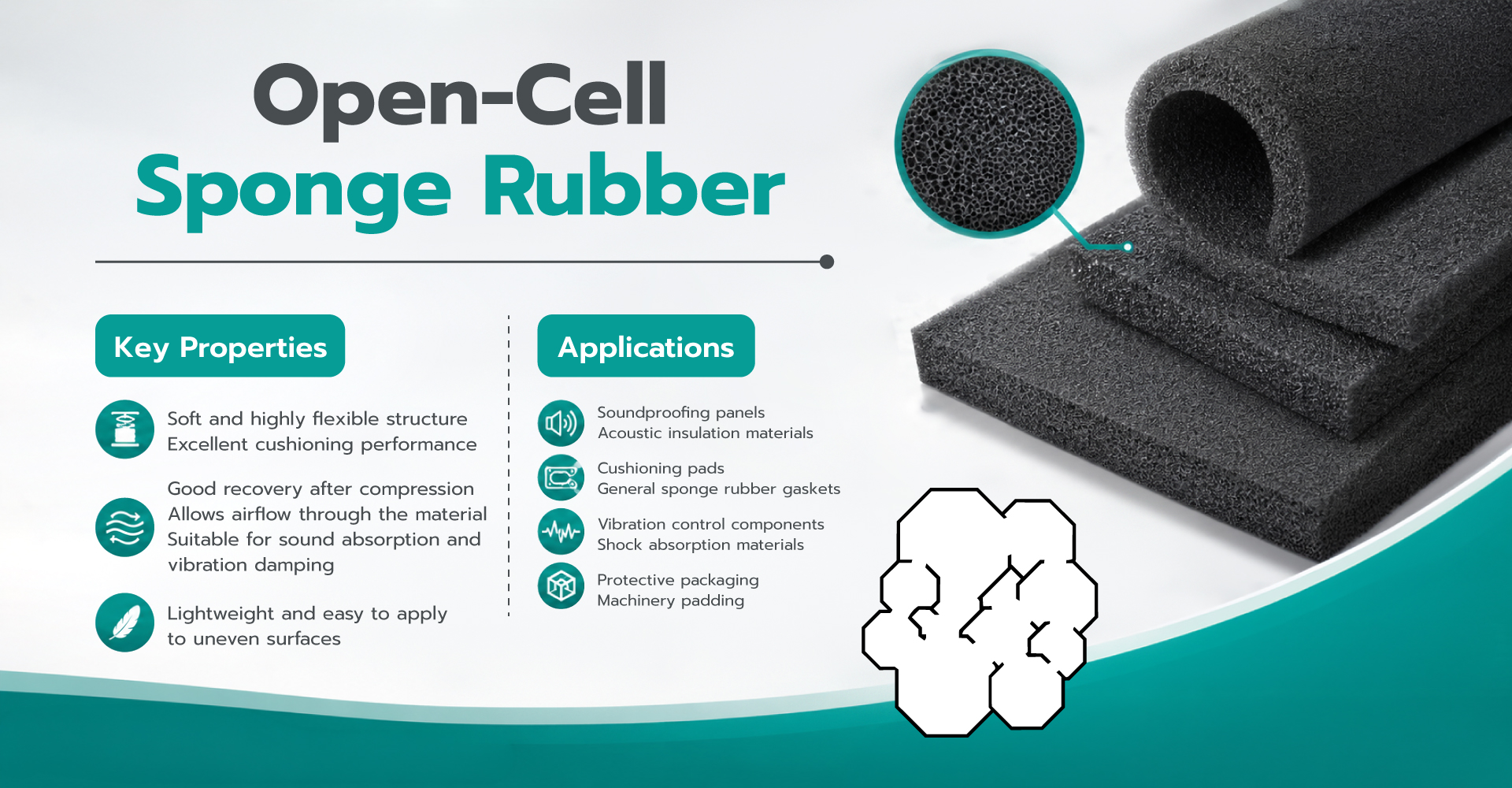
Key Properties of Open-Cell Sponge Rubber
Open-cell sponge rubber offers several advantages:
Soft and highly flexible structure
Excellent cushioning performance
Good recovery after compression
Allows airflow through the material
Suitable for sound absorption and vibration damping
Lightweight and easy to apply to uneven surfaces
Because air can pass through the cells, open-cell sponge rubber is not the best choice for waterproof sealing. Instead, it is preferred when softness, comfort, impact absorption, and acoustic performance are the main requirements.
Common Applications of Open-Cell Sponge Rubber
Open-cell sponge rubber is commonly used for:
Soundproofing panels
Acoustic insulation materials
Cushioning pads
General sponge rubber gaskets
Vibration control components
Shock absorption materials
Protective packaging
Machinery padding
For projects that require soft compression, noise reduction, or impact protection, open-cell sponge rubber is often an ideal solution.
What Is Closed-Cell Sponge Rubber?
Closed-cell sponge rubber has air cells that are sealed and separated from one another. Each cell is enclosed by rubber walls, preventing air, gas, and liquid from passing through easily.
This structure gives closed-cell sponge rubber excellent sealing performance. It is widely used in applications that require protection against water, dust, air leakage, weather exposure, and moisture.
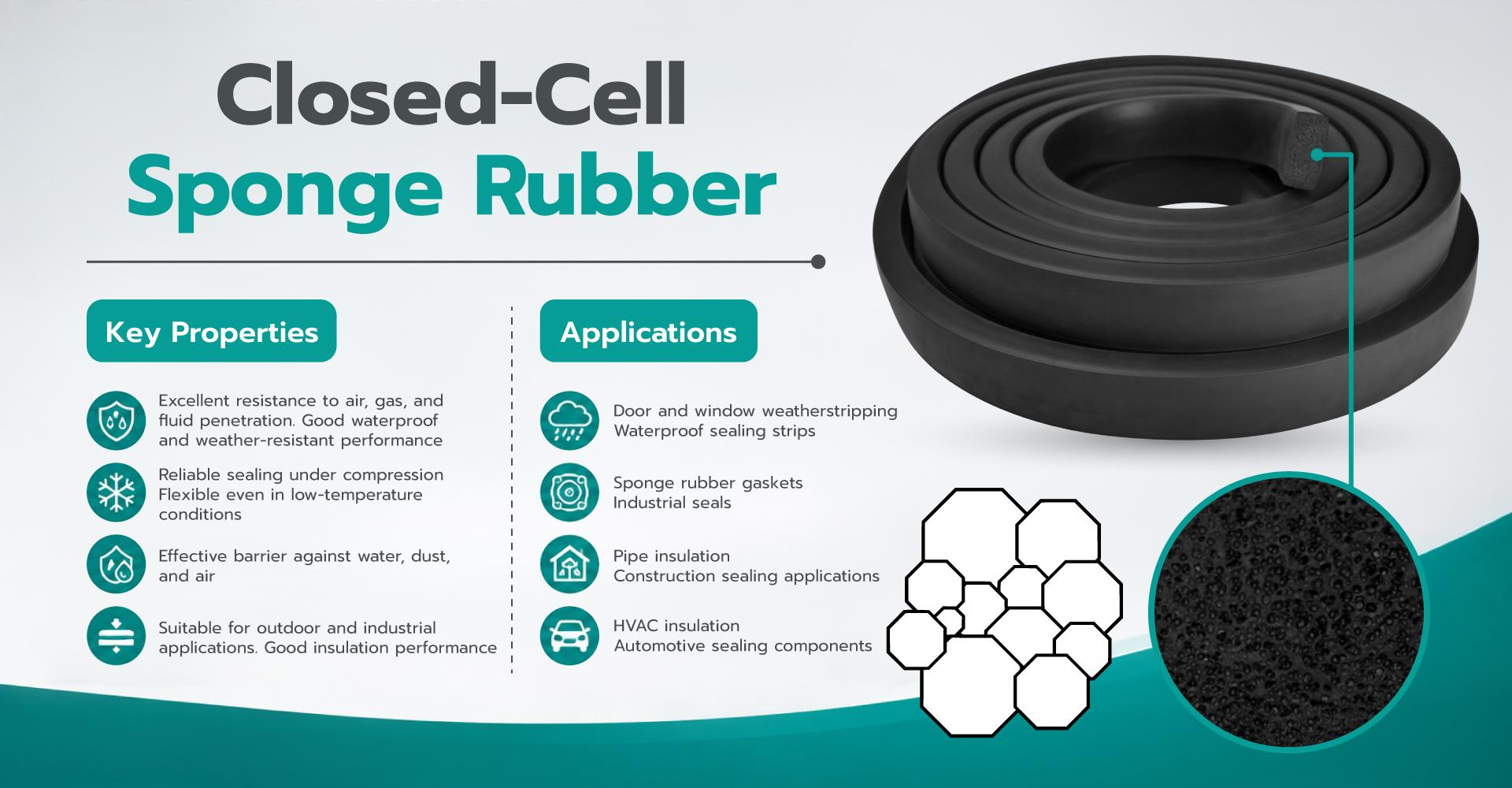
Key Properties of Closed-Cell Sponge Rubber
Closed-cell sponge rubber provides strong functional benefits:
Excellent resistance to air, gas, and fluid penetration
Good waterproof and weather-resistant performance
Reliable sealing under compression
Flexible even in low-temperature conditions
Effective barrier against water, dust, and air
Suitable for outdoor and industrial applications
Good insulation performance
Because of these properties, closed-cell sponge rubber is the preferred choice for sealing, weatherstripping, insulation, and fluid-resistant applications.
Common Applications of Closed-Cell Sponge Rubber
Closed-cell sponge rubber is widely used in:
Door and window weatherstripping
Waterproof sealing strips
Sponge rubber gaskets
Industrial seals
HVAC insulation
Automotive sealing components
Pipe insulation
Construction sealing applications
Dust, air, and moisture protection
When the main requirement is to seal against water, dust, air, or weather conditions, closed-cell sponge rubber is usually the better option.
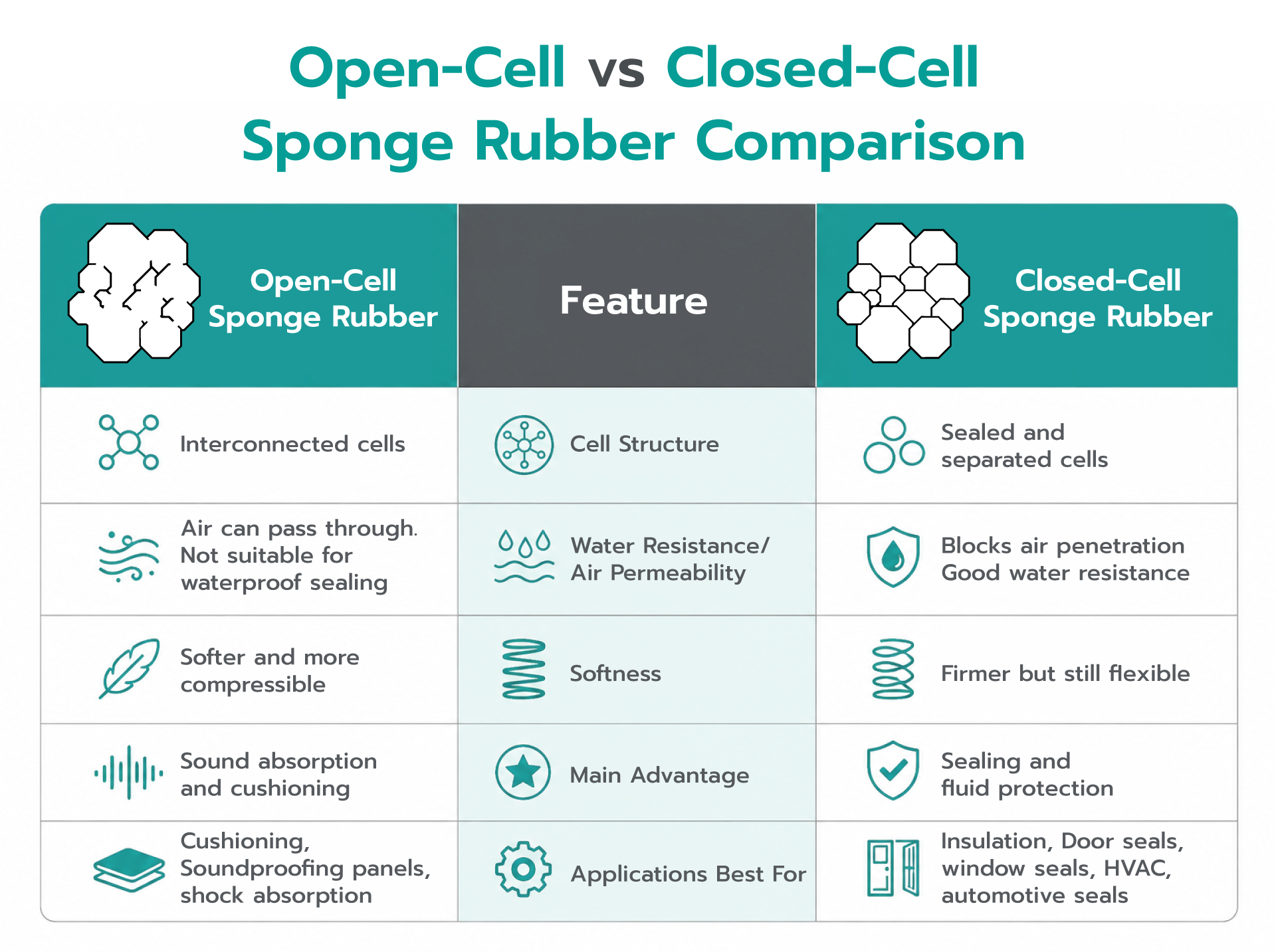
How to Choose the Right Sponge Rubber for Your Application
Choosing between open-cell and closed-cell sponge rubber depends on the final use of the material.
Choose Open-Cell Sponge Rubber If You Need:
Soft cushioning
Shock absorption
Vibration damping
Sound absorption
Lightweight padding
Flexible material for uneven surfaces
Open-cell sponge rubber is ideal when comfort, compression, acoustic control, or impact protection is more important than waterproof sealing.
Choose Closed-Cell Sponge Rubber If You Need:
Waterproof sealing
Air and dust protection
Weather resistance
Moisture resistance
Reliable gasket performance
Insulation for HVAC or construction applications
Automotive or outdoor sealing performance
Closed-cell sponge rubber is the better choice when sealing, durability, and environmental protection are the top priorities.
Manufacturing Forms of Sponge Rubber
The manufacturing process also affects the final form of sponge rubber products.
Open-cell sponge rubber is often produced in:
Sheets
Pads
Press-molded parts
Cushioning components
Closed-cell sponge rubber is commonly produced through:
Extrusion process
Custom rubber profiles
Weatherstripping profiles
Sponge rubber tubes
Large sponge blocks or sheets
Cut-to-size gaskets and seals
At SAPONG™, sponge rubber can be supplied in various materials, densities, thicknesses, shapes, and custom profiles depending on the application requirements.
Common Sponge Rubber Materials
The base rubber polymer has a major impact on performance. Different applications may require different types of sponge rubber materials.
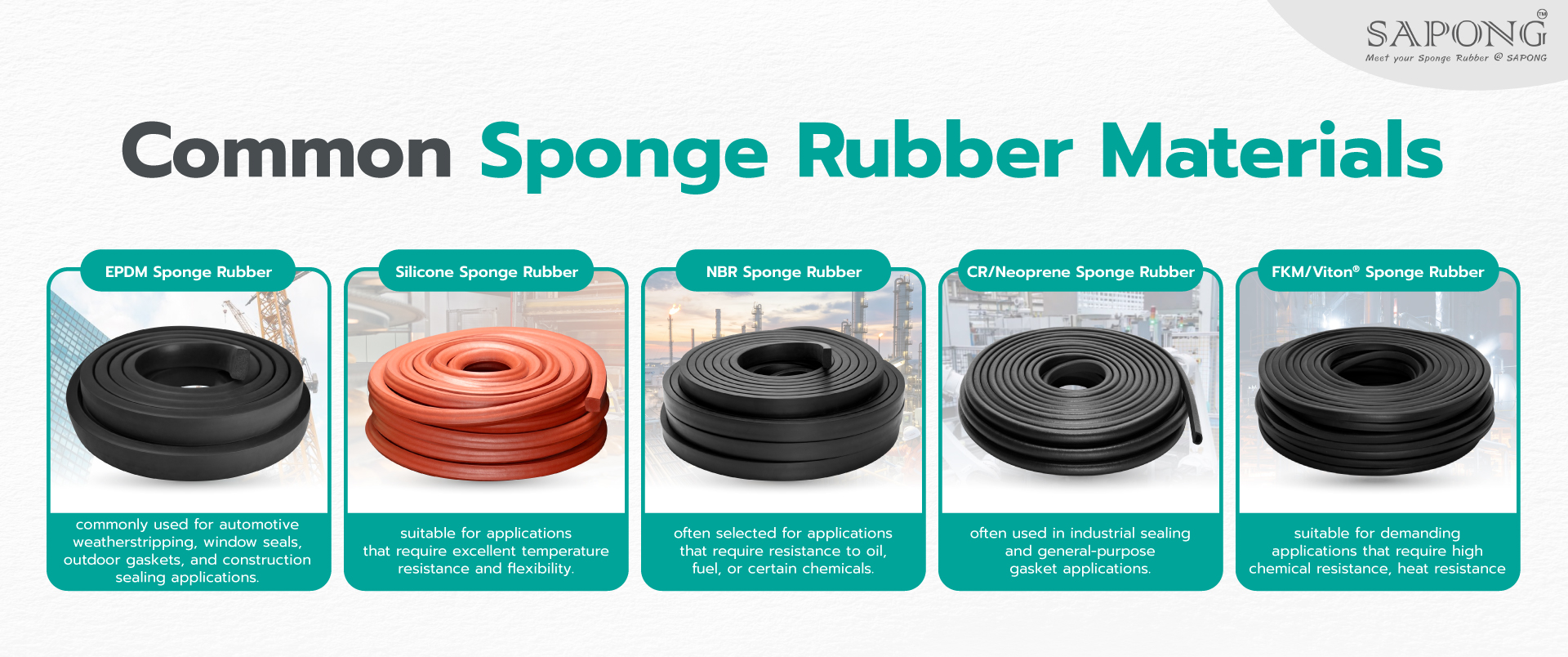
EPDM Sponge Rubber
EPDM Sponge Rubber is one of the most popular choices for outdoor applications because it offers excellent resistance to:
Ozone
UV exposure
Weathering
Aging
Outdoor environments
EPDM sponge rubber is commonly used for automotive weatherstripping, window seals, outdoor gaskets, and construction sealing applications.
Silicone Sponge Rubber
Silicone Sponge Rubber is suitable for applications that require excellent temperature resistance and flexibility. It is commonly used in electrical, food-related, medical-related, and high-temperature sealing applications, depending on the grade and specification.
NBR Sponge Rubber
NBR Sponge Rubber, also known as nitrile sponge rubber, is often selected for applications that require resistance to oil, fuel, or certain chemicals. It is commonly used in industrial gaskets, sealing parts, and machinery applications.
CR / Neoprene Sponge Rubber
CR sponge rubber, or neoprene sponge rubber, offers a balanced combination of weather resistance, oil resistance, and mechanical performance. It is often used in industrial sealing and general-purpose gasket applications.
FKM / Viton® Sponge Rubber
FKM sponge rubber is suitable for demanding applications that require high chemical resistance, heat resistance, and long-term durability.
Frequently Asked Questions About Sponge Rubber
What is sponge rubber?
Sponge rubber is a type of cellular rubber made by adding a blowing agent to a rubber compound. During curing, small air cells form inside the rubber, making it lightweight, flexible, compressible, and suitable for sealing, cushioning, insulation, and sound damping applications.
What is the difference between open-cell and closed-cell sponge rubber?
Open-cell sponge rubber has interconnected cells that allow air to pass through, making it suitable for cushioning, vibration damping, and sound absorption. Closed-cell sponge rubber has sealed cells that resist air, gas, and liquid penetration, making it ideal for sealing, weatherstripping, and insulation.
Which sponge rubber is better for sealing?
Closed-cell sponge rubber is better for sealing because it resists moisture, air, dust, and gas penetration. It also provides reliable compression sealing performance and remains flexible across a wide range of applications.
Is open-cell sponge rubber waterproof?
No. Open-cell sponge rubber is not recommended for waterproof sealing because its connected cell structure allows air and moisture to pass through. It is better suited for cushioning, sound absorption, and vibration control.
Is closed-cell sponge rubber waterproof?
Closed-cell sponge rubber offers good resistance to water and moisture because its sealed cell structure helps block fluid penetration. It is commonly used for waterproof sealing strips, weatherstripping, gaskets, and outdoor sealing applications.
What are common uses of open-cell sponge rubber?อ
Open-cell sponge rubber is commonly used for soundproofing panels, cushioning pads, vibration control parts, shock absorption materials, protective packaging, and general sponge rubber pads.
What are common uses of closed-cell sponge rubber?
Closed-cell sponge rubber is commonly used for door and window weatherstripping, HVAC insulation, automotive seals, industrial gaskets, waterproof seals, dust seals, and moisture-resistant sealing applications.
Can sponge rubber be customized?
Yes. Sponge rubber can be customized by selecting different rubber materials such as Silicone, EPDM, NBR, CR / Neoprene, NR, or FKM, as well as different densities, thicknesses, hardness levels, profiles, cutting shapes, curing methods, and adhesive backing options.
Which Sponge Rubber Is Right for Your Project?
Both open-cell and closed-cell sponge rubber have unique strengths.
If your project requires soft cushioning, sound absorption, shock protection, or vibration control, open-cell sponge rubber is often the right choice.
If your project requires waterproof sealing, dust protection, air sealing, weather resistance, or insulation, closed-cell sponge rubber is usually the better solution.
Choosing the right sponge rubber helps improve product performance, reduce maintenance issues, and prevent unnecessary costs caused by using the wrong material.
Need Help Choosing the Right Sponge Rubber?
The SAPONG™ Sales Engineer team is ready to help you select the right sponge rubber for your application. We can support you from material selection to density, thickness, profile design, cutting size, adhesive tape backing, and custom production requirements.
Whether you need open-cell sponge rubber, closed-cell sponge rubber, EPDM sponge rubber, Silicone sponge rubber, NBR sponge rubber, sponge rubber gaskets, weatherstripping, HVAC insulation, or custom rubber sealing parts, SAPONG™ can help recommend the most suitable solution for your project.
Contact SAPONG™ today for technical consultation.
LINE : @ptirubber | Email : info@ptigroups.com
Tel : +662-257-7154 | MB : +6698-289-8676 | +6686-307-7319
SAPONG™ by Polytech Industry Company Limited


