Why Engineers Choose Viton® Over High-Heat Silicone Rubber
616 Views |

In industrial manufacturing, rubber seals, gaskets, and rubber sheets are not simple components—
they are critical safety systems that protect the entire machine.
Even a small failure—cracking, swelling, deformation, or leakage—can lead to:
• unexpected downtime
• loss of materials
• chemical leakage
• heat escaping from systems
• higher maintenance costs
• and serious safety risks
One material that engineers consistently rely on for heavy-duty conditions is the Viton® (FKM) Rubber Sheet—a premium fluoroelastomer designed for high temperature, oil, chemical, and fuel exposure.
Yet one question is always asked:
“If Silicone can handle +250°C to +270°C, why pay more for Viton® which handles around +260°C?”
The answer is simple:
Industrial heat never comes alone.
It comes with oil, chemicals, pressure, vapor, and mechanical stress.
And this is where Silicone fails—but Viton® survives.
Misconception: “For high heat, choose the highest heat-resistant rubber.”
Silicone appears to be the perfect choice because of its temperature rating.
But in real industrial environments, temperature is only one variable.
High-heat applications usually involve:
- hydraulic oil, engine oil, lubricants
- diesel, kerosene, fuel oil
- strong chemicals (acids, alkalis)
- solvents (Toluene, MEK, Acetone)
- fuel vapor
- pressure and compression
- abrasion and repeated mechanical load
- thermal cycling (rapid temp changes)
This is where Silicone quickly fails and where Viton® is engineered to perform.
This is why more than 90% of engineers choose Viton® for applications involving
heat + oil + chemicals + vapor simultaneously.
7 Engineering Reasons Viton® Outperforms Silicone Rubber Sheets
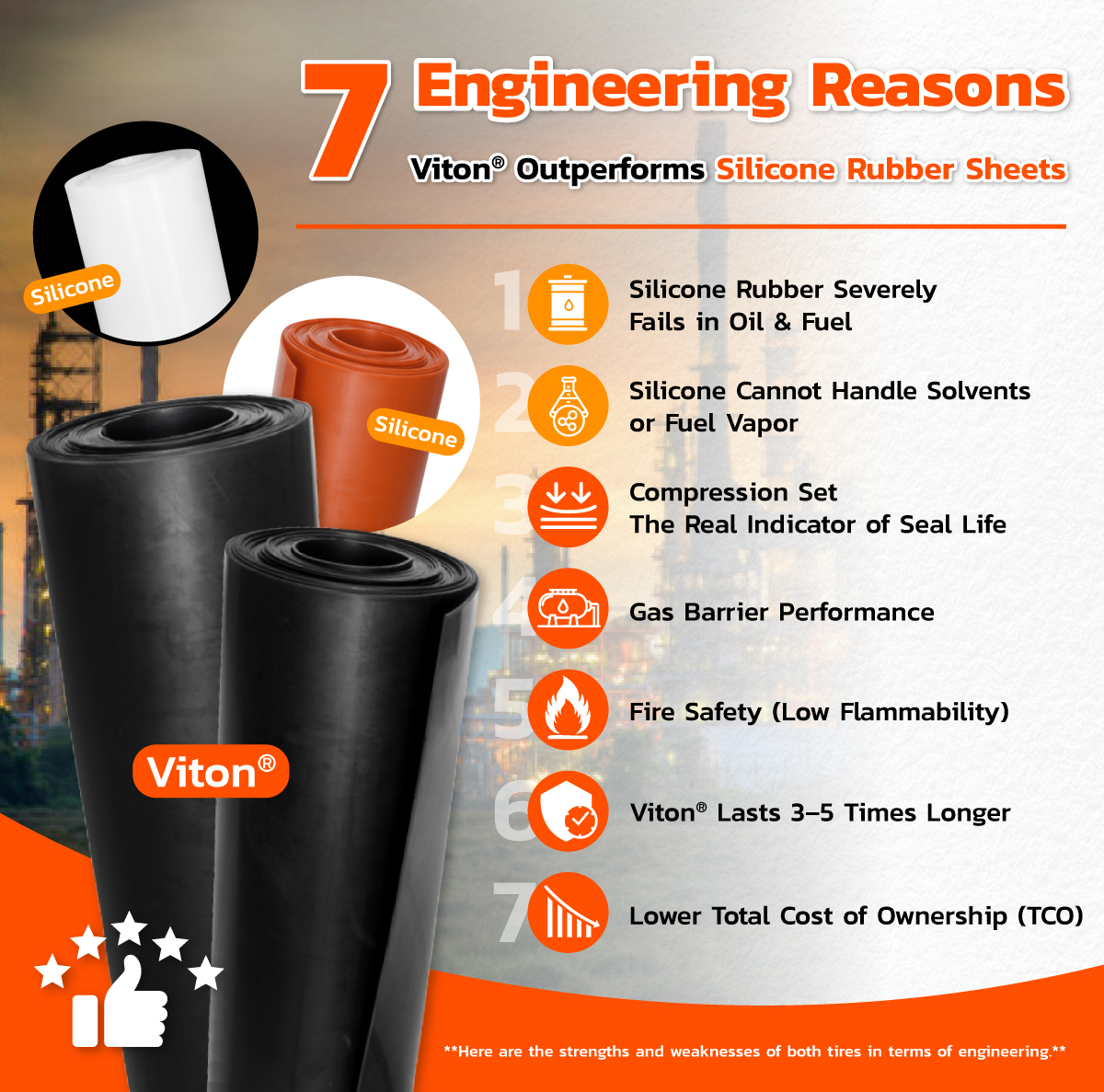
1. Silicone Rubber Severely Fails in Oil & Fuel
When exposed to hydraulic oil, engine oil, lubricants, diesel, or fuel:
Silicone will:
- swell
- soften
- deteriorate
- lose sealing function
2. Silicone Cannot Handle Solvents or Fuel Vapor
Solvents such as Toluene, MEK, Acetone, Ketones, and Fuel Vapor
penetrate Silicone rapidly due to its high molecular permeability.
This causes:
- swelling
- softening
- cracking
- rapid seal failure
3. Compression Set: The Real Indicator of Seal Life
Compression Set measures how well rubber returns to shape under long-term load.
Silicone:
- deforms permanently
- loses sealing force
- causes leakage
Viton®:
- low compression set
- maintains sealing pressure
- ideal for flanges, ovens, vacuum systems
4. Gas Barrier Performance
Silicone = High Gas Permeability
Viton® = Low Gas Permeability
This makes Viton® essential for:
- fuel systems
- chemical tanks
- vapor-sensitive applications
- high-risk sealing environments
5. Fire Safety (Low Flammability)
Silicone can ignite under direct flame depending on formulation.
Viton® tends to self-extinguish and has inherently low flammability.
6. Viton® Lasts 3–5 Times Longer
In real industrial use:
Silicone may require replacement every 3–6 months.
Viton® often lasts 1–3 years or longer.
7. Lower Total Cost of Ownership (TCO)
Even though Viton® costs more upfront, it reduces:
- replacement frequency
- downtime losses
- maintenance labor
- safety risks
Viton® vs Silicone Rubber Sheet Comparison

When Is Silicone Rubber a Good Choice?
Silicone is excellent when the only requirement is heat.
Use silicone when:
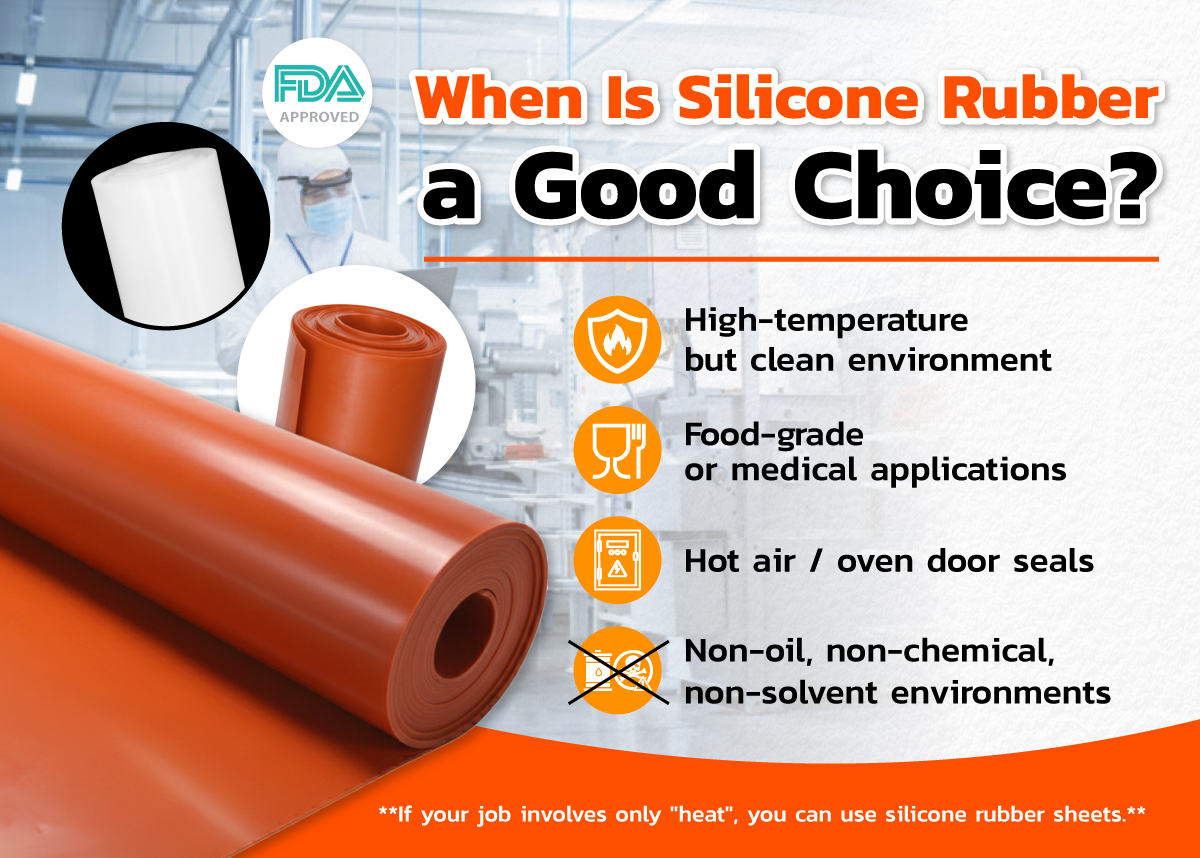
- High-temperature but clean environment
- Food-grade or medical applications
- Hot air / oven door seals
- Non-oil, non-chemical, non-solvent environments
When You Must Choose Viton®
Use Viton® when your application involves:
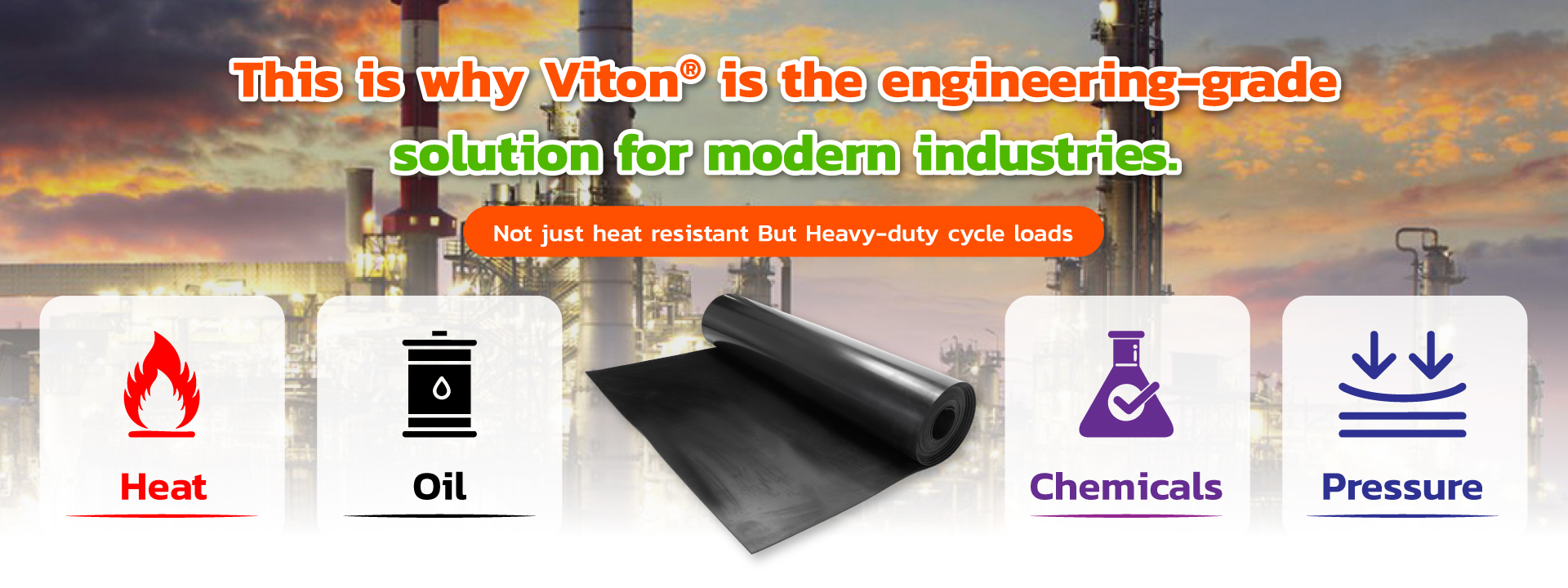
- heat + oil
- heat + chemicals
- heat + solvent vapor
- heat + pressure
- heavy-duty cycle loads
Contact the Viton® Rubber Sheet Experts
If you need truly reliable, chemical-resistant, high-heat rubber sheets—
HyperSheet® by Polytech Industry is ready to assist.
“Rubber sheets you can trust — precision-tested, standard-certified, engineered by experts.”
Contact us:
LINE OA: @ptirubber
WhatsApp: +66863077319
www.polytechindustry.co.th
info@ptigroups.com
HyperSheet® — Engineered by Polytech Industry Co., Ltd.


