Reinforced Rubber Sheet vs Rubber Diaphragm
438 Views |

In industrial applications,
some decisions appear minor on a quotation sheet,
yet they can generate significant cumulative costs over the long term.
This issue is not caused by poor material quality,
nor is it the fault of the plant or procurement team.
It is most often the result of incomplete or unclear technical guidance from suppliers.
Many factories are led to believe that reinforced rubber sheets and rubber diaphragms are interchangeable—simply because both are described as fabric reinforced, because they look similar externally,and because the technical differences are rarely explained in detail.
In reality, these two rubber products are designed for fundamentally different operating principles—from design intent and internal construction,to real operating behavior and system service life.
When these differences are overlooked, selection decisions tend to default to price comparison alone,causing the true cost to extend far beyond the initial purchase price.
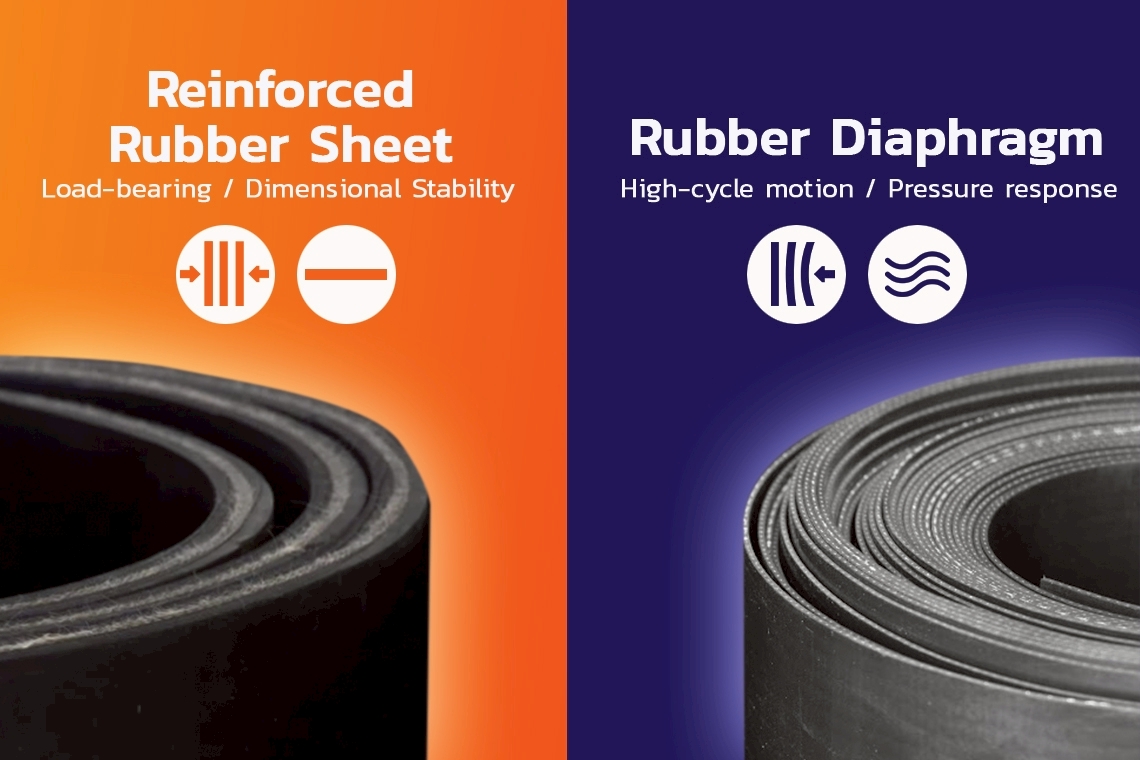
Reinforced Rubber Sheet
A reinforced rubber sheet is an industrial rubber product designed with a clear design intent to withstand compressive load, tensile load, and tear stress under conditions where dimensional stability is required.
The core design objective is structural strength, not flexibility.
Internally, reinforced rubber sheets are typically constructed with multiple layers of fabric reinforcement—
such as canvas or polyester—to:
- Increase tensile and compressive strength
- Improve tear resistance
- Control deformation under prolonged mechanical load
Because of this design logic, reinforced rubber sheets are best suited for applications that involve:
- Static load
- High impact load
- Little to no cyclic movement
Typical Applications
- Hopper, chute, and conveyor door seals
- Shot blasting / sand blasting liners
- Large industrial gaskets
- Applications involving continuous material weight or impact
In real operation, a reinforced rubber sheet functions as a load-bearing component,not as a moving or pressure-responsive element.
Key Characteristics
- High compressive and tensile strength
- Excellent tear resistance
- Good dimensional stability over time
In simple terms:
A reinforced rubber sheet is a rubber component that must withstand load while remaining stationary.
Not Suitable For
- Continuous expansion and contraction
- High-cycle dynamic movement
Using reinforced rubber sheets outside this intent often leads not only to premature replacement, but also to unplanned downtime and system-level damage.
Rubber Diaphragm
A rubber diaphragm is specifically engineered for continuous, repetitive movement under pressure.
Its primary function is not load bearing, but to convert pressure into controlled mechanical motion under changing operating conditions. Rubber diaphragms are designed to:
- Respond consistently to pressure fluctuations
- Operate under high-cycle dynamic conditions
- Maintain controlled stroke and motion direction
Accordingly, their design focuses on dynamic performance and fatigue resistance, rather than static structural strength.
Typical Applications
Rubber diaphragms are widely used in systems requiring precise, stable movement, such as:
- Diaphragm pumps and metering pumps
- Control and pressure-regulating valves
- Pneumatic and hydraulic actuators
- Pressure-driven control systems
In these systems, rubber diaphragms act as dynamic sealing and motion-control components,not as structural supports.
Key Characteristics
- Fast elastic recovery
- Capable of hundreds of thousands to millions of cycles
- Consistent pressure response
- Chemical, fluid, and gas resistance (compound-dependent)
- Controlled permeation as required by system design
A rubber diaphragm is a rubber component engineered for precise, repetitive motion under pressure.
Not Suitable For
- High static compressive load over long periods
- Direct impact load
- Structural load-bearing roles
Misapplication commonly results in deformation, tearing, leakage, and reduced system control.
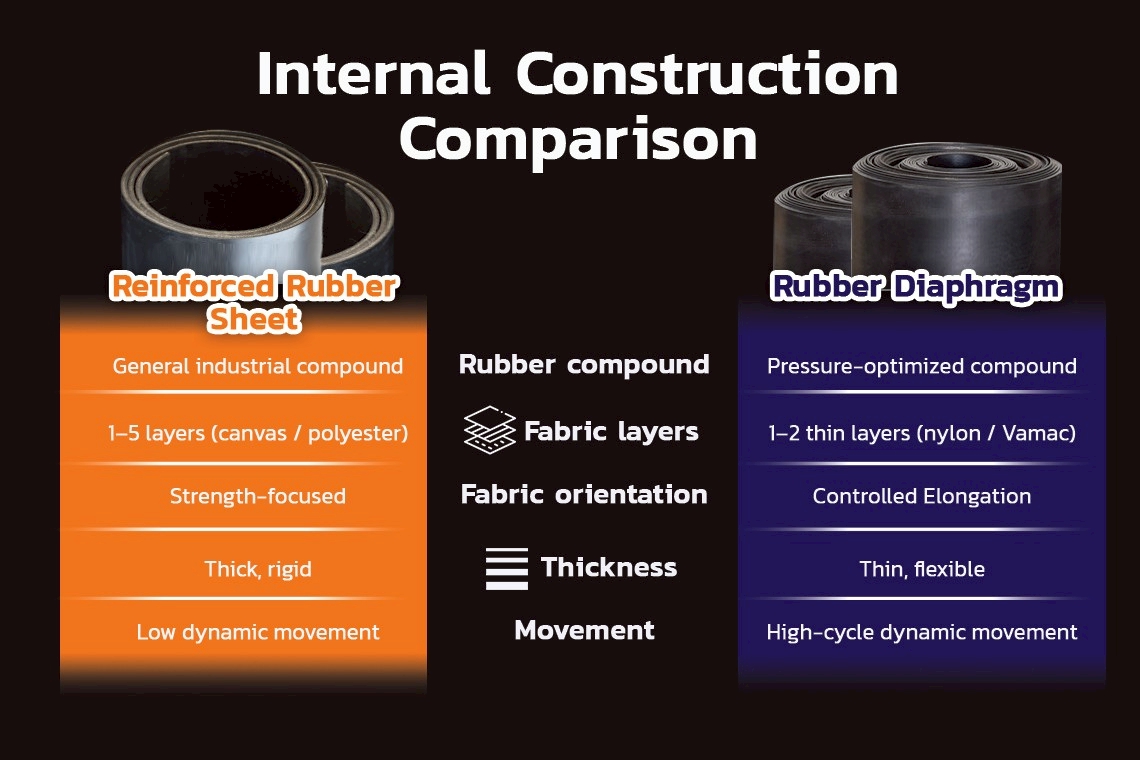
The same fabric material, when oriented differently,
can produce dramatically different performance and service life.
This is a critical detail that non-specialized suppliers often fail to explain.
Real Operating Behavior
Reinforced Rubber Sheet – In Practice
When used as intended, reinforced rubber sheets:
- Support static load effectively
- Maintain shape without warping
- Resist heavy impact from bulk materials
However, because they are optimized for strength,
they are not suitable for frequent expansion or continuous movement.
If incorrectly recommended for pressure-driven systems, common failures include:
- Early material fatigue
- Cracking along reinforcement layers
- Premature leakage
These issues often lead to unplanned downtime and escalating maintenance costs.
Rubber Diaphragm – In Practice
When applied correctly, rubber diaphragms:
- Operate smoothly over hundreds of thousands to millions of cycles
- Respond rapidly and consistently to pressure changes
- Maintain elasticity and sealing performance
Because flexibility is prioritized, rubber diaphragms are not designed to withstand prolonged static load or heavy impact.
When misused as structural components, typical problems include:
- Permanent deformation
- Tearing due to stress concentration
- Rapid loss of system efficiency
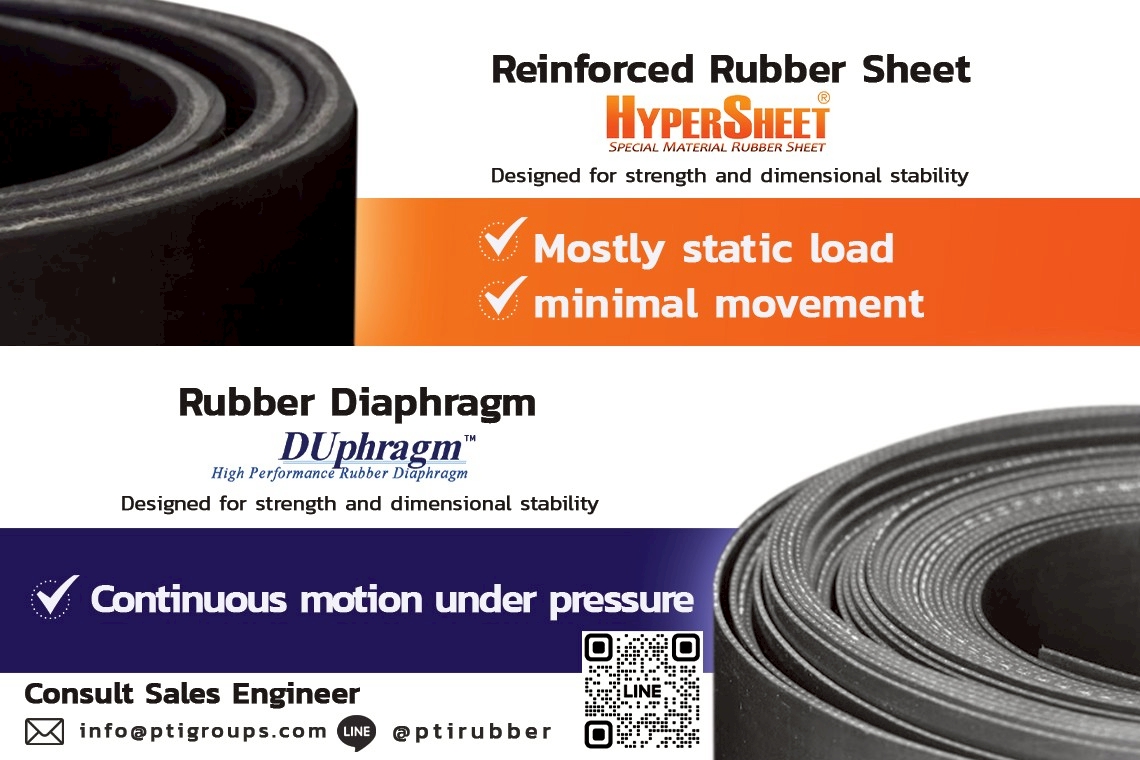
Load-bearing, minimal movement applications
→ Reinforced Rubber Sheet
(e.g., HyperSheet® product group)
Continuous movement, pressure-driven applications
→ Rubber Diaphragm
(e.g., DuPhragm™ product group)
Understanding the real operating behavior of each rubber type
significantly reduces selection risk
and helps control total cost of ownership (TCO) from the outset.
If you would like to:
- Verify suitability for your actual operating conditions
- Receive technical guidance before final selection
- Request a quotation or custom specification
Consult directly with our Sales Engineering team
LINE Official: @ptirubber
Email: info@ptigroups.com
Correct rubber selection does not start with price.
It starts with a true understanding of how your system works.
FAQ – Frequently Asked Questions
Can reinforced rubber sheets and rubber diaphragms be used interchangeably?
No. Although both may be described as fabric-reinforced, they are designed for completely different functions and operating conditions.
When should a reinforced rubber sheet be selected?
When the application primarily involves static load or impact load, with little or no movement, and long-term dimensional stability is required.
When should a rubber diaphragm be selected?
When the system requires continuous movement, repeated expansion and contraction under pressure, and precise motion control.
What happens if the wrong type of rubber is selected?
Common issues include material fatigue, tearing, leakage, unplanned downtime, and significantly higher total cost of ownership (TCO).
Why can a lower-priced product become more expensive in the long term?
Because the real costs occur after installation—such as frequent replacements, downtime, and ongoing maintenance expenses.
What information should be prepared before selecting a rubber product?
Movement characteristics (none or continuous, frequency of cycles), operating pressure or load, chemical or fluid exposure, and leakage or permeation requirements.
What should be done if the application requirements are unclear?
Consult a Sales Engineer to evaluate the actual operating conditions before finalizing the specification.


